



Title: The Elusive 2-Door Manual Integra: Why America’s Enthusiasts Keep Getting Teased (and What It Means for 2025)
The dust has barely settled on the 2025 Guangzhou Auto Show, and already, the automotive world is buzzing – and for American enthusiasts, a familiar sting of disappointment is echoing. Amidst the usual array of electric vehicles and futuristic concepts, a particular creation from GAC-Honda caught the collective eye: a two-door Integra with a manual transmission and a removable targa top. On paper, it sounds like a dream machine, a nostalgic nod to Honda’s glory days, perfectly tuned for drivers who still crave engagement. But as someone who’s spent a decade navigating the intricate currents of the global automotive market, I can tell you this: don’t hold your breath for it to land on American shores. This isn’t just about a cool car; it’s a stark illustration of divergent market strategies, regulatory hurdles, and the ever-shrinking niche for pure driving machines in a landscape increasingly dominated by utility and electrification.
Unveiling the Unicorn: What Exactly Did GAC-Honda Show?
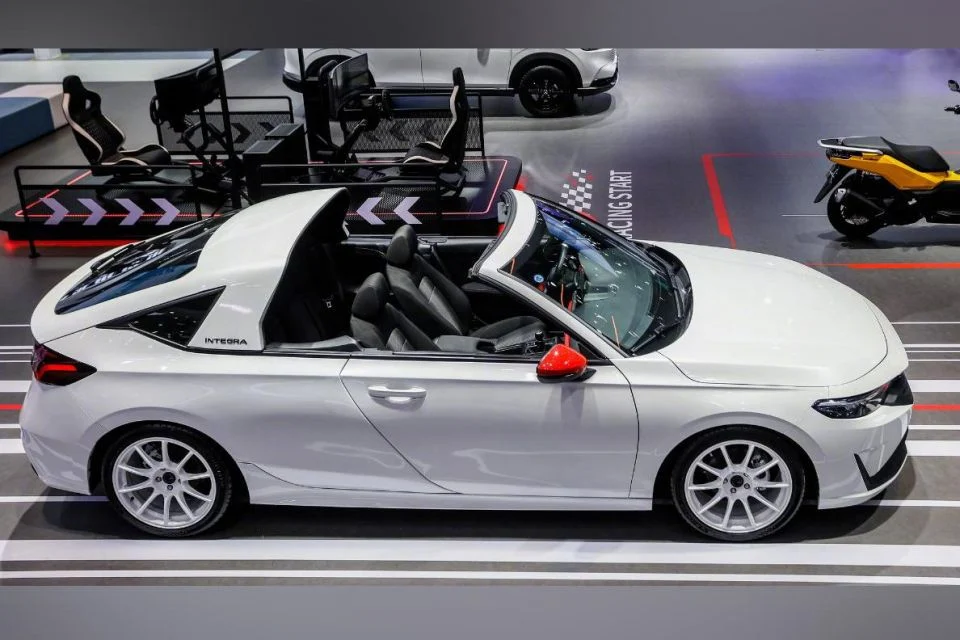
Let’s dissect this intriguing concept first. What GAC-Honda presented wasn’t simply a re-badged Acura Integra from the U.S. market. Far from it. This was a ground-up transformation, leveraging the architecture of a Honda Civic hatchback – specifically, the one sold as an Integra in China under the GAC-Honda joint venture – and radically reimagining its form. The most striking alteration, of course, is the eradication of the rear doors, instantly morphing it into a proper two-door coupe. But they didn’t stop there. The roofline received a dramatic rework, culminating in a colossal, removable targa panel, evoking fond memories of the legendary Honda Del Sol.
Under the hood, the choice of powertrain solidified its enthusiast appeal: the well-regarded turbocharged 1.5-liter four-cylinder engine, crucially paired with a manual transmission. In an era where the manual gearbox is fast becoming an endangered species, seeing one prominently featured in a concept car, particularly with such a playful intent, is akin to spotting a rare bird. The styling cues were equally bold: pristine white exterior paint, matched by white multi-spoke wheels, contrasted sharply with bright red mirror caps and subtle red trim accents throughout the cabin. The “Integra” badge, usually an understated affair, was proudly emblazoned along the side, making a statement. Even with rear seats conspicuously present in a car designed for two-door targa fun – a curious design choice that suggests it might have been more of a styling exercise than a production-ready blueprint – the overall package screamed “driver’s car.”
From an expert perspective, this build is fascinating. It showcases the engineering prowess within Honda’s global operations, demonstrating what’s possible when designers and engineers are given creative license. It’s a testament to the enduring appeal of traditional sports car configurations, even in a market like China that typically gravitates towards sedans and SUVs. But the very elements that make it so desirable to purists are also precisely why its journey across the Pacific seems insurmountable.
The Chasm of Disparity: Why This Integra Won’t Cross the Ocean
The immediate, heart-wrenching reality for American enthusiasts is that this GAC-Honda Integra is definitively not destined for production, let alone for sale in the United States. And for those of us who’ve watched the market evolve over the past decade, this isn’t a surprise; it’s a predictable outcome rooted in a complex interplay of market dynamics, regulatory frameworks, and brand strategies.
Firstly, let’s address market demand and consumer preferences in the United States. For years now, the American automotive landscape has been relentlessly reshaped by the SUV and crossover boom. Sedans, coupes, and particularly niche two-door manual vehicles, have seen their market share dwindle to almost microscopic levels. While there’s a vocal contingent of enthusiasts who pine for such vehicles, their numbers, unfortunately, aren’t sufficient to justify the massive investment required for homologation, manufacturing, and distribution of a completely new body style. The sports coupe market in 2025 is a brutal arena, dominated by a handful of established players, many of whom are struggling to maintain sales volumes without significant incentives. A brand-new, niche two-door targa, even with its undeniable charm, would face an uphill battle against the prevailing consumer appetite for practicality, space, and all-weather capability.
Secondly, regulatory hurdles and homologation costs present a formidable barrier. Introducing a fundamentally new body style like a two-door targa requires extensive crash testing, emissions certifications, and adherence to myriad safety standards specific to the U.S. market. These processes are incredibly expensive and time-consuming. For a vehicle that’s unlikely to sell in significant volumes, the return on investment simply doesn’t add up. Honda’s focus, like many major automakers, is rightly placed on scaling profitable models, particularly performance compact cars that can appeal to a broader segment or high-volume EVs that align with future environmental mandates. Diverting resources to certify a bespoke low-volume model for a single market segment that’s in decline makes little business sense.
Then there’s the internal brand strategy for Honda and Acura in the U.S. We already have the Acura Integra, which, while a premium compact hatchback/sedan and not a true coupe, occupies the “Integra” space. We also have the highly capable Honda Civic Si and the formidable Civic Type R, both offering manual transmission cars 2025 that cater to performance enthusiasts. Introducing another unique, two-door, manual-equipped vehicle could confuse brand messaging, potentially cannibalize sales from existing models, and dilute the clear segmentation Honda has worked hard to establish. From a corporate standpoint, clarity and efficiency in product portfolio are paramount.
Furthermore, the very nature of GAC-Honda as a joint venture in China means their product development often caters specifically to the unique preferences and regulations of the Chinese market. These ventures are designed to adapt global platforms to local tastes, and sometimes, those adaptations yield fascinating results that have no direct analogue or utility in other regions. It’s less about denying the U.S. something cool and more about fulfilling a specific regional purpose or exploring creative design avenues for local engagement.
Nostalgia and the Ghost of the Del Sol
The mention of the Honda Del Sol is not accidental; it’s a crucial emotional anchor for understanding the yearning this GAC-Honda Integra concept evokes. The Del Sol, produced from the early 90s to the mid-90s, was Honda’s answer to an affordable, fun-to-drive, two-seat targa-top roadster. It wasn’t a powerhouse, but it offered an open-air experience, Honda reliability, and that intangible “fun factor” that defined a generation of Japanese performance cars. For many, it represented a golden era of motoring – a time when Honda performance parts were readily available, and affordable enthusiast cars were plentiful.
This new concept taps directly into that nostalgia. It reminds us of a time when manufacturers weren’t afraid to experiment with body styles beyond the ubiquitous sedan and now, the SUV. It speaks to the purists who lament the loss of driver engagement, who see the future of sports cars dwindling into complex, heavy, and increasingly autonomous machines. The idea of a lightweight, FWD, manual targa Integra is almost a fantasy, a “what if” scenario that plays out in the minds of those who learned to drive stick on an old Civic Si or dreamed of a CRX.
But the reality of 2025 is starkly different from the 1990s. Manufacturing costs are higher, safety standards are exponentially more stringent, and the global supply chain is infinitely more complex. Recreating the Del Sol experience today would mean either a significantly higher price tag, compromises on modern amenities, or a direct clash with existing product lines. While the emotional pull is undeniable, the business case for such a vehicle in the current enthusiast car market trends is incredibly tenuous.
Beyond the Concept: Implications for the Future of Driving
So, if this GAC-Honda Integra is just a tantalizing glimpse of what could be, what does its existence tell us about the broader automotive landscape?
Firstly, it demonstrates that the spirit of innovation and playful design still thrives within major automakers, even if it’s confined to regional concept stages. It shows that there are still engineers and designers who understand and appreciate the art of the enthusiast car. This is a glimmer of hope amidst the electrification onslaught.
Secondly, it underscores the growing segmentation of global markets. What resonates in China, or even Japan (where unique, smaller segment vehicles often thrive), doesn’t necessarily translate to North America or Europe. Automakers are increasingly tailoring products to specific regional tastes, leading to an intriguing diversity of vehicles that we, unfortunately, don’t always get to experience globally. This divergence means that while we may see incredible concepts like this one, our options for niche limited edition vehicles or bespoke body styles might become increasingly restricted to premium segments or specialized manufacturers.
Thirdly, it highlights the perceived value of manual transmission cars in 2025. Even if not production-bound, the deliberate inclusion of a stick shift in a concept car, presented on a global stage, sends a message. It signals that manual transmissions still hold cultural cachet, embodying a connection to driving that many still cherish. Whether this translates into a resurgence in sales is debatable, but it certainly keeps the conversation alive about the importance of driver involvement.
Finally, for those who view cars not just as transportation but as an automotive investment, the scarcity of unique, driver-focused vehicles means that existing classic examples, or truly bespoke future models from low-volume manufacturers, will only grow in value and desirability. This GAC-Honda concept, while not a collectible itself, feeds into the narrative of “the cars they don’t make anymore,” inadvertently driving interest in the secondary market for genuine enthusiast machines. The thought of a modern convertible sports cars with true driver engagement from a mainstream manufacturer is becoming rarer by the year.
The Enduring Allure and the Road Ahead
The GAC-Honda 2-door manual Integra targa is a bittersweet reminder of what could be, and a clear signal of the realities of the 2025 automotive market. It’s a fantastic design exercise, a testament to the creativity within Honda, and a poignant callback to an era of unadulterated driving fun. But for U.S. enthusiasts, it remains firmly in the realm of “forbidden fruit.”
As experts with a decade of immersion in this industry, we understand the logistical and economic reasons behind its exclusivity. We see the automotive import regulations, the shifting consumer preferences, and the corporate strategies that prioritize scale and efficiency. Yet, the heart of a gearhead still longs for something more – something raw, something engaging, something that prioritizes the driver above all else. This concept, however fleeting, reminds us that the spark of that desire still flickers.
What are your thoughts on this GAC-Honda Integra? Do you believe the US market is truly ready for a revival of niche, manual-transmission vehicles, or are we destined for a future dominated by SUVs and EVs? Share your insights and join the conversation on the future of automotive passion and the models we truly crave.